The Plaque That Says More Than Its Words
Reading a commemorative plaque carefully helps you tell what it records from what it leaves open, and choose a sensible next source to consult.
Reading a commemorative plaque carefully starts with a small but useful question: what does this marker establish about the place, beyond the words it prints? A plaque can identify a person, event, or public decision, but its position and design also shape how passersby meet that subject.
What does the plaque ask you to notice?
Look first at the marker’s physical relationship to the site. Is it fixed to the building it names, set beside a path, or grouped with other memorials? Does its placement make it part of an entrance, a route through the grounds, or a stop apart from ordinary foot traffic?
Those choices affect how people encounter a commemoration. A plaque beside a doorway may greet visitors as they enter; one on a garden wall may invite a pause. The placement is observable. The reason for choosing it is not, unless a record or accompanying explanation says so.
Notice what surrounds the marker, too. A dedication ceremony might have left a wreath holder, a small paved area, or a nearby sign; another plaque might share the same wall. These details show how the memorial sits within the public space, not necessarily how the community feels about it now.
How does a plaque shape a public place?
A marker can turn an ordinary corner into a place where visitors are expected to pause. Its height, orientation, and relation to a bench or walkway can make reading easy or awkward. A plaque facing the path addresses passersby; one turned toward a building may be easier for people already familiar with the site to find.
Consider access without treating it as an explanation of intent. If lettering is blocked by shrubs or placed beyond a gate, fewer people may encounter it during a casual visit. That is a practical observation about access, not proof that anyone meant to hide the marker.
Likewise, a plaque’s presence does not show that every resident knows its subject or agrees with its message. Public commemoration is visible; public opinion is not. Keep those two things separate, even when the marker is prominent.
What should you record about its setting?
For a useful account, focus on the site’s arrangement rather than trying to capture every detail. Record what a visitor could verify: the marker’s location, its relation to nearby features, and any practical barrier to seeing or approaching it. If the lettering itself matters, transcribe it separately and distinguish exact wording from your description.
- Approach: If a public path leads directly to the marker, describe that route; if access is blocked or unclear, note the barrier and check posted visitor guidance before going farther.
- Orientation: If the plaque faces a walkway, note that passersby can see it; if it faces a wall or enclosed area, describe the limited viewing angle without guessing why.
- Nearby features: If another sign, marker, or memorial is visible, note its position and wording; if none is present, do not infer that the plaque was intended to stand alone.
- Visibility: If plants, glare, or building features obstruct the marker, record what is obscured; if the surface is clear, note that the text is plainly visible from the public approach.
- Use of the space: If the marker sits beside a doorway, path, or seating area, describe that relationship; if the space has no obvious visitor route, avoid assigning it a ceremonial purpose.
- Access rules: If a sign gives visiting hours or restrictions, follow them; if no rule is posted, stay in clearly public areas and ask the site manager about uncertain access.
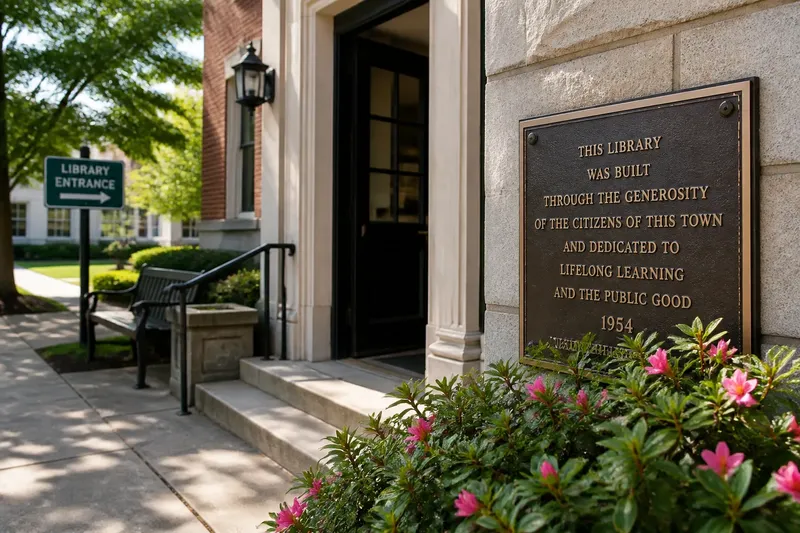
Say you arrive at a town library to look at a plaque on its east entrance. You see that the lettering faces the public walkway, but a flowering shrub partly covers the final line; a small directional sign points to the entrance, and the door is open to visitors. You write down the location and visible obstruction, then read the plaque from the unobstructed side rather than stepping into the planted bed. The resulting description can say that the marker faces the walkway and that its last line is partly obscured; it cannot claim the shrub was placed to conceal the text.
How can you check what the placement means?
Start with the people responsible for the site. A library, parks department, historical society, or building manager may know when the marker was installed, who maintains the surrounding area, and whether the location has changed. Ask a narrow question: for example, whether the plaque was moved when an entrance was renovated.
For a historical account, consult records that bear on the site’s use: municipal meeting minutes, building plans, dedication programs, or local newspaper archives. Each source answers a different question. A plan may show where a plaque was mounted; minutes may record an installation decision; neither necessarily explains what every visitor thinks of it.
If the question is about how people use the space now, observe the public setting without treating a brief visit as a measure of community opinion. Note visible paths, signs, and access arrangements. For formal conclusions about a site or its history, ask a qualified local historian or the relevant records office for guidance.
What do readers ask about a plaque’s setting?
Does a plaque’s location explain why it was installed there?
Location shows where visitors encounter the marker, but it does not establish the reason for the choice. Look for a dedication program, meeting record, or site manager’s account before stating a motive.
What can a plaque reveal about access to a public place?
Its route, visibility, and any posted restrictions show practical conditions for reaching and reading it. They do not, by themselves, explain why those conditions exist.
Should nearby memorials be treated as part of the same story?
Record their proximity and wording, then check whether a sign or site record links them. Shared space alone does not establish a shared purpose.
What if the plaque is difficult to see?
Describe the specific obstruction or viewing angle, and do not alter landscaping or cross a restricted area to get a better view. A site manager can clarify access or help identify a suitable way to read the marker.
What is not worth the effort?
It is not useful to infer a community’s priorities from the plaque’s material, size, or nearby landscaping alone. A prominent position can make a marker easy to encounter; it cannot tell you who supported it or how residents respond to it.
Nor does every marker require a full investigation. If you simply want to understand how it sits within the place, describe its route, visibility, and immediate surroundings. If the location matters to a public account, check records that document the installation and keep any unanswered question in view.
Reading a commemorative plaque carefully includes noticing the space that carries it: who can approach, what else competes for attention, and what a visitor can actually see. That modest account is often enough to guide the next question. When you return to the plaque’s wording, you can distinguish its message from the setting that gives it a public audience.