Library Noticeboard or Printed Leaflet? How Local Information Gets Read
Choose a library noticeboard or printed leaflet for the way residents encounter information, so event details stay visible, consistent and easy to revisit.
Should a local event go on the library noticeboard or into a printed leaflet? For library noticeboard or printed leaflet decisions, start with the moment a resident needs the information: while passing through, or later when planning a visit. A noticeboard catches people already in the building; a leaflet can go home with them.
The formats work best as separate routes to the same facts. Before posting, decide what a passer-by must understand and what someone might need to carry away. That distinction makes the copy easier to edit and helps prevent two versions from quietly disagreeing.
What does each format help a reader do?
A noticeboard helps visitors notice several local activities in one place. People may see it while returning books, waiting for a computer, or checking opening hours. It is useful for announcements whose main purpose is to prompt an immediate decision: ask for details, attend, or take a leaflet.
Its weakness is that visibility depends on location and attention. Someone who does not pass the board will miss the notice, and a crowded display can make a posted sheet hard to spot. A notice has to compete with its neighbours, not merely occupy a respectable patch of cork.
A take-away leaflet helps a reader keep details for later. It can include directions, a contact route, or practical information someone may want to consult away from the library. But a leaflet only helps if it is easy to pick up and clear without the board beside it.
Neither format is automatically more accessible. Use readable type, plain wording, and a layout that does not hide essential facts. If someone needs a different format or access information, include a reliable way to ask for it.
How should the two formats divide the work?
Give each format a distinct job. The board should answer the quick questions: what is happening, when and where, who it is for, and how to ask for more information. The leaflet can repeat those essentials and add details a person may need later.
Keep the facts aligned. Use the same event name, date, place name, and contact route on both pieces. If one changes, update the board and remove or clearly mark outdated leaflets. A reader should not have to decide which version has the newer venue.
For details that change often, keep the current information with the responsible organisation and make printed material point to a named, usable source where appropriate. Avoid relying on a vague instruction such as “check online”; give a clear service name or contact route. For access, eligibility, or public-service rules, confirm the wording with the responsible organisation before circulating it.
What should you check before printing or posting?
- Check that the event name states what the activity is; if it is clear, use it on both formats, but if it is vague, rewrite it before printing.
- Check that the date and time are confirmed; if they are, publish them consistently, but if they are not, wait or give a clear contact route for updates.
- Check that the venue name and entrance guidance are accurate; if a first-time visitor can find the place, use that wording, but if not, ask the venue for a clearer direction.
- Check that the intended audience is stated; if people can tell whether the activity is for them, keep the wording, but if not, clarify who may attend or enquire.
- Check that a reader can ask a question without searching elsewhere; if the contact route is current, print it, but if it is not, confirm it with the organiser first.
- Check that the leaflet remains useful on its own; if it includes the essential details, place it where visitors can take it, but if it depends on the board, revise it.
- Check that the sheet is legible and not crowded by nearby notices; if the heading and key facts stand out, post it, but if not, simplify the copy or choose a clearer position.
There is little value in producing a leaflet just because a notice exists, or pinning several copies of the same sheet around the building. More paper does not create more routes to the information. Make a second format only when it gives the reader something useful to notice, carry, or revisit.
Which format suits common local announcements?
Which format suits information a reader must carry?
A leaflet is useful when someone may need directions, preparation details, or a contact point after leaving the library. Put those details on the leaflet itself rather than asking readers to remember a board notice.
Which format helps readers compare local activities?
A noticeboard can place several activities side by side, making it easier for visitors to spot an option. Group related notices under clear headings if the display allows it; if categories make the board harder to scan, keep the arrangement simple.
What should happen when an event detail changes?
Correct the board promptly and remove or mark any leaflets carrying the old information. If the change affects whether or how someone can attend, provide a direct contact route and confirm the updated detail with the organiser.
How much detail belongs on each format?
Include what is happening, when and where, and how to ask for more information on both. Add supporting details to the leaflet, but keep the notice concise enough to read while standing at the board.
How can a reader revisit the information?
Give readers a dependable route back to the details. A leaflet can name the organising group or service desk; a notice can say where leaflets are available. Avoid “see board for details” on a take-away sheet: the board is unlikely to accompany anyone to the bus stop.
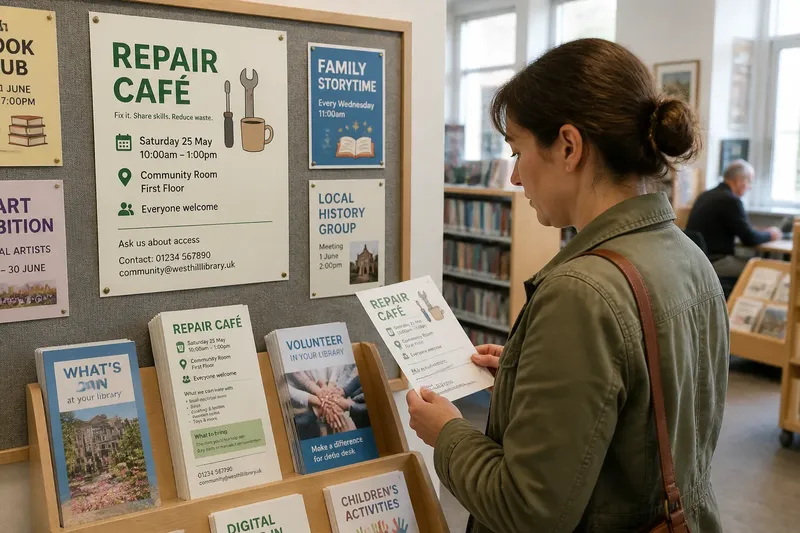
Imagine a library is announcing a repair café, and the confirmed details are its name, meeting date, community-room location, and organiser contact. The noticeboard sheet uses those details and says visitors can ask about access through the contact route. The leaflet repeats them, then adds what kinds of items organisers can discuss and what visitors should bring. A staff member spots a room change before the event: they replace the board sheet, remove the old leaflets, and put out corrected copies. The resulting decision is straightforward: the board prompts interest, while the leaflet supports planning, and neither leaves readers with the superseded location.
If the event is simple and one clear notice contains everything a reader needs, a separate leaflet may add no value. For a library noticeboard or printed leaflet, choose the format by the reader’s next action: notice the announcement in the building, or keep useful details for later.